
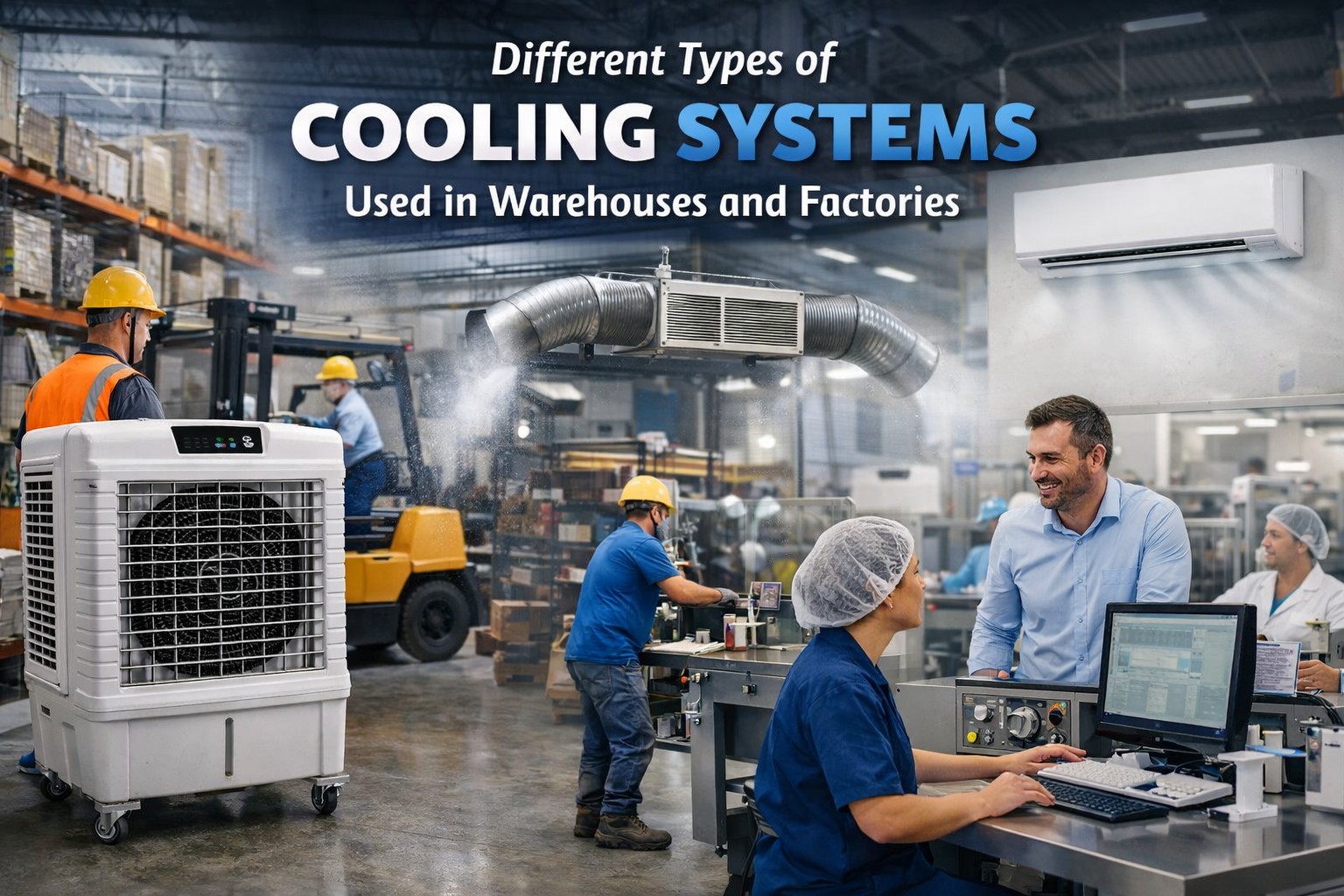
Cooling systems play a pivotal role in any factory, warehouse or manufacturing plant. They maintain heat and create a productive and safe environment for both machines and the working staff. They are a must, especially for chemicals, food, medicines and other sensitive products because heat can damage them.
The good thing is that manufacturers offer specialised cooling solutions to protect products, extend equipment life, and keep workers safe. They design different types of systems, such as commercial coolers, evaporative cooling systems, chilled water systems, air conditioning systems (refrigeration), hybrid systems, and ventilation systems.
If you are a facility manager looking for a way to manage intense heat in the industrial space, here are different types of cooling systems.
Commercial Coolers for Large Volumes
The commercial air coolers are common in the warehouses, workshops and high air volume assembly areas. They draw in warm air using pads that are wetted with water and force cold air into the area. These units suit semi-open environments like fabrication units, a packaging area or storage halls where it is not viable to fully air-condition them.
The key advantages of commercial coolers are:
- High airflow to cool the large, open spaces.
- Compared to refrigeration and other HVAC systems, it consumes low power.
- Features large water tanks for long operation hours.
- Also suitable for semi-open and ventilated areas.
If you need one for your warehouses or factories, it is good to deal with reliable commercial cooler manufacturers and select the right model for industrial use.
Evaporative Cooling Systems
The evaporative cooling is achieved by allowing the warm air outside to flow through wet media, which cools down its temperature prior to entering a building. They are typically put in place in centralised form where they are connected to the ductwork, and they supply cooled air over large workspaces.
Its important features are:
- Energy-efficient cooling options.
- Continuously supplies fresh air from outside.
- Provides relief from a hot and dry climate.
- Lower operational cost compared while being effective.
Air Conditioning Systems
Refrigeration technology is applied in air conditioning to remove heat and maintain a constant interior temperature. It is normally applied in closed areas that require exact temperature regulation. The pharmaceutical, electronics, laboratories and food processing industries are among the industries that use air conditioning to ensure that the environment remains strict.
The main benefits of this system are:
- Humidity control is also provided along with precise temperature regulation.
- A fully enclosed space gets better air quality.
- Also suitable for temperature sensitive space like laboratories.
- Indoor climate remains consistent and comfortable.
Chilled Water Systems
Large industrial buildings that require cooling in different parts use chilled water systems. A central chiller is used to cool the water, and it is pumped into pipes to air handling units of various locations. The cool water takes the indoor heat and passes back to the chiller, where it is cooled again.
Here are the main benefits of a chilled water system:
- Works as a central unit with better management for large facilities.
- Multiple zones have uniform temperature and humidity.
- Works efficiently even in demanding conditions.
- Suitable for large factories, processing plants and industrial complexes
- It can be scaled when the facility is expanded.
Plastic-Body Coolers To Combat Corrosion
In humid or coastal areas, metal bodies corrode faster. So plastic coolers are used. Since these cooling systems are made of plastic, they resist rust and last longer. When these units are industrial-sized, they perform just as well as metal ones.
The key is capacity, not material. If airflow and tank size match the space, plastic-body units work fine in factories.
Key Takeaway
Choosing the right cooling system is essential for maintaining a safe, efficient, and productive environment in warehouses and factories. From commercial air coolers and evaporative cooling systems to air conditioning and chilled water systems, each solution is designed to meet specific industrial cooling needs. By selecting the appropriate system based on space size, ventilation, climate, and operational requirements, facility managers can effectively control heat, protect equipment and products, and ensure worker comfort while keeping energy costs under control.
Frequently Asked Questions
Commercial air coolers and evaporative cooling systems are commonly used as they effectively cool large and semi-open spaces.
They provide energy-efficient cooling and continuously supply fresh air, making them ideal for industrial environments.
Yes, plastic-body coolers resist rust and corrosion, making them suitable for humid or coastal industrial areas.